Face to a Name
In 2024 I started a little pet project “Face to a Name”. While walking the dog through my local cemetery I see lots of WW1 and WW2 graves. As Lincoln is known as “Bomber County” we have a lot of RAF stations and casualties from both wars.
During WW1 Lincoln has several hospitals and rehabilitation centres were located here such as The 4th Northern General Hospital (which later became Christ Hospital School) so a lot of soldiers from all over the world were brought here and buried locally when they died.
I saw a US WW1 grave which is quite unusual so decided to find a little bit more about him and decided I would like to put faces to a few more of the men and women of the armed services who are laid to rest here, so I started researching these service men and women and placing laser engraved plaques of their faces as a form of remembrance.
Private Joseph Hiserodt Sharpe was the son of Lewis K. and Margaret H. “Maggie” (nee HISERODT) SHARPE. He was born in Natchez, Adams County, MS in October 1896.
During World War I, Joseph became a Cadet with the American Army, Aviation Section, Signal Corps. On the 7th of January 1918, whilst flying a Dehavilland 6 training aircraft over what is now RAF Waddington, Lincoln, England, Joseph was killed in an accident when his aircraft dived into the ground.
Apparently the accident occurred on the last day of training.


1232 Private Wilfrid Ernest Peart 4th Pioneer Battalion was born in Glen Innes NSW and was the son of A J Johnstone from Linda Valley in Tasmania. He was a miner prior to enlisting on 9th October 1914 at the age of 19. He served in Egypt, Gallipoli, France and England and was wounded in action twice 7/5/16 and 15/8/16 before dying of his wounds on the 12/11/16.


SECOND LIEUTENANT H. S. KITSON AUSTRALIAN FLYING CORPS
Harold Strachan Kitson was born at Moonee Ponds, Victoria on 26th October, 1894 to parents James & Annie Kitson. Harold attended Camberwell State School, Victoria & Jercho’s Business College, Victoria.
Harold Strachan Kitson applied for a Commission in the Australian Flying Corps, A.I.F. on 24th October, 1916. He listed his educational qualifications as Merit Certificate & his Military qualifications as “1 year Senior Cadets, 4 years Citizen Forces 48th Infantry Lieutenant.”
Lieutenant (rank as per Embarkation Roll) Harold Strachan Kitson embarked from Melbourne, Victoria on HMAT Ulysses (A38) on 25th October, 1916 with the “C” Flight, 2nd Australian Flying Squadron & disembarked at Devonport, England on 28th December, 1916.
Second Lieutenant Harold Strachan Kitson was taken on strength of No. 68 Squadron, Harlaxton on 13th May, 1917 from A.F.C. Details ex No. 63 Squadron, R.F.C
Second Lieutenant Harold Strachan Kitson returned to No. 68 Squadron, A.F.C., Harlaxton on 4th June, 1917 from School of Aerial Gunnery at Turnberry.
Second Lieutenant Harold Strachan Kitson was detached for duty with No. 45 Training Squadron from 11th June, 1917
On 15th June, 1917 Second Lieutenant Harold Strachan Kitson was piloting a Sopwith Serial number B1734 from No. 45 Training Squadron, South Carlton, Lincolnshire, England when his plane crashed.
Second Lieutenant Harold Strachan Kitson died on 15th June, 1917 as a result of an aeroplane accident 3 miles N.E.of South Carlton near Lincoln, England.
A Court of Enquiry was held on 16th June,.1917 at South Carlton Aerodrome “for the purpose of inquiring into the circumstances whereby Lt Kitson, H.S. A.F.C. No. 45 T.S. met his death in aeroplane accident on the 15th June, 1917 about three miles N.E. of South Carlton. On Sopwith Scout. 1734.”
A Telegram was sent on 18th June, 1917 from Aeronautics 45, Lincoln to Adminaust, London which reads “2/Lieut H. S. KITSON was killed on Friday 15.6.17 owing to a spinning nose drive whilst flying Sopwith Scout No. 1734 80 HP Lerohne No. 35135/WD10984.”
Second Lieutenant Harold Strachan Kitson was entitled to British War Medal only as he had not entered a Theatre of War.
A Memorial Scroll & Memorial Plaque were also sent to Second Lieutenant Kitson’s father – Mr J. Kitson, as the closest next-of-kin. (Scroll sent December, 1921 & Plaque sent December, 1922)


Please find more information on this website link
Family Plots and Personal Headstones
When the Imperial War Graves Commission as it was known was first introduced there was a lot of anger from families as it established strict rules for a uniform style of commemoration. Many people saw this as state-controlled mourning and felt they were losing the right to make personal choices on how and where their family members would be remembered. (Please read the full story of the CWGC here )
Some families chose to opt out of the war graves commissions offer and chose to have their loved ones buried in family plots. Many of these still had the CWGC headstones and these are lovingly tended and maintained by the commission. Some, however chose to have personal headstones in their family plot. While these would have been looked after by the families, over the years these some of these families have died out or moved away and these graves have often deteriorated, as they do not fall under the CWGC remit they are often in a state of disrepair and it is often difficult to identify these as war graves in order remember, honour and commemorate these members of the armed forces.
Captain Guy Patrick Spence Reid
Born in the 18th May 1897 in Puerto Cruz, Tenerife, Guy was the son on Thomas (Vice Consul) and Lisette Reid. He passed out from Sandhurst and was commissioned as a second lieutenant in the Seaforth Highlanders on 11th August 1915. On 21st October 1915 he was appointed a flying officer and seconded to No20 Sq Royal Flying Corp being sent to France in January 1916.
Guy Patrick Spence Reid was a WW1 flying ace and is credited with 5 victories
| Date | Time | Unit | Aircraft | Oponent | ||
| 1 | 07 Feb 1916 | 0900 | 20 | F.E.2b 1 | Fokker E (DD) | Roulers |
| 2 | 01 Jul 1916 | 0530 | 20 | F.E.2b (A11) 2 | Fokker E (DES) | Wervicq |
| 3 | 03 Aug 1916 | 0930 | 20 | F.E.2b (A19) 2 | Aviatik C (OOC) | Hollebeke |
| 4 | 31 Aug 1916 | 0855 | 20 | F.E.2b 2 | Fokker E (DD) | Boeschere |
| 5 | 06 Sep 1916 | 1245 | 20 | F.E.2b (A19) 3 | Fokker E (OOC) | Passchendaele |
He was awarded the Military Cross for “Conspicuous skill and gallantry” on 26th September 1916 and on 30th October was appointed flight commander with the temporary rank of captain.
In December 1916 Guy returned to England to serve as a flying instructor in Lincolnshire and was promoted to lieutenant on 1st January 1917. On 16th October 1917, Guy (still only 20) while instructing second lieutenant Cameron of Aberdeen their aircraft, a Shorthorn S11 A4134 crashed at RFC South Carlton (World War One Incident Logs – BCAR.org.uk) killing both men.


Private Thomas Lewis Briggs
Born on 1st July 1895 the son of T. Arthur and Dora Briggs, of Killarney Manitoba. Private 424038 Thomas was a member of the Canadian Infantry (Saskatchewan Regiment) 5th Battalion and died of his wounds in Lincoln Hospital.
Private Briggs was one of the first Wesley College Students to enlist and reached France in the summer of 1915. He was drafted into 5th battalion and fought in the trenches for a year, then was severely wounded in one leg. He was removed to Lincoln hospital and progressed favourably, until a fall broke his leg and led to amputation. The shock killed him
Thomas was wounded and gassed at Ypres on 6-4-16 and died on 2-10-16 at the age of 21


Cadet (Bombardier) Harry Collier Warren
Harry Collier Warren was born at Port Pirie, South Australia in 1893. He attended St Peter’s College 1906-1911 and while there served in the School’s cadet unit.
He later studied law and when he enlisted in Perth on 17 August 1914 was an articled clerk for the firm of Penny & Hill.
His mother died while he was very young so he was raised by his sister Marjory; their father must have died during 1909 for in the May 1910 issue of the School Magazine it is reported that William’s older brother took over the family farm.
At the end of October 1914, he sailed from Fremantle with 8th Battery, 3rd Field Artillery Brigade aboard HMAT Medic.
The 8th Battery commanded by Major Alfred Bessell-Brown was among the first Australian field artillery batteries to see action at Anzac. The battery landed on 26 April but due to unsuitable terrain and the lack of gun positions were returned to the ship late the same day but were brought ashore again on the evening of 1 May.
By the time the 8th Battery was evacuated in December it had seen repeated action and was involved in numerous heavy engagements at Anzac.
In February, while at Tel- el- Kebir Barracks, 1899 Driver Warren was promoted to Bombardier and proceeded to France in March.
In late November, he was accepted to attend the Australian Flying Corps School of Instruction and with hopes of a bright future, marched in to No 69 Squadron Royal Flying Corps at South Carlton near Lincoln, England on 3 March 1917. Cadet (Bombardier) Harry Collier Warren was killed in an aeroplane accident during training on 4 April 1917; he was 23 years of age.
An inquest held the day after Harry’s death found he had been accidently killed while flying as a pupil in a machine with a second lieutenant as the pilot.
The airmen had taken off in the Avro 504B B389 for a period of dual instruction, during which the aeroplane entered a spinning nose dive from about 150 feet. 2nd Lt Lowry reported afterwards that he was unable to use the rudder to recover from the spin. The Court of Enquiry opined that the rudder problem may have been due to Cadet Warren’s attempted use of it.
The accident report stated that the machine began to spin, and in spite of the efforts of the pilot the controls would not work properly. It was suggested that the rudder was jammed by air pressure.”
Virtual War Memorial | Harry Collier WARREN (vwma.org.au)
Accident Avro 504B B389, Wednesday 4 April 1917 (flightsafety.org)


Second Lieutenant Orville Dwight Haist
37th Training Reserve Sqdn RFC
Orville was born 3rd March 1894 in Fonthill, Ontario and was the son of Mr Jacob M Haist and Mrs Haist. He joined the Canadian Officers Training Corp in 1915 – 1917.
In January 1917 he joined the Royal Flying Corps and went to England for his training. He qualified for his commission in June.
A few days before he was to leave for the front, when making a trail flight at Scampton near Lincoln on the evening of July 3rd 1917 Orville aged 23 was flying an Armstrong Whitworth F.K.8 Serial Number A272 when the engine stalled and the aeroplane crashed.
He was taken to No 4 Northern General Hospital and succumbed to his injuries 2 day later July 5th 1917
Orville Dwight Haist – The Canadian Virtual War Memorial – Veterans Affairs Canada
Fatal air accidents in Britain Jan – Jul 1917 (rcawsey.co.uk)


2nd Lieutenant Geoffrey SULMAN
Geoffrey G. Sulman was a Second Lieutenant in the Royal Flying Corps (RFC), and his journey is marked by both determination and tragedy.
Geoffrey Sulman was from from Lawson, Australia. His father, Sir John Sulman, was a renowned architect and town planner and his mother Lady Lawson. Geoffrey grew up in Lawson, Australia surrounded by the picturesque Blue Mountains.
When Geoffrey attempted to enlist in the Australian Imperial Force (AIF), he faced a medical rejection. Undeterred, he set his sights on Britain. There, he enlisted in the RFC.
On 16th June 2017 while flying a Royal Aircraft Factory B.E.2 Serial number A8676 at 51 Training, Squadron, Waddington and instructing 2Lt Douglas William Dron the aircraft spun off during a low turn and crashed, Injuring both Douglass and Geoffrey.
Geoffrey died of his injuries two days later 20/6/17 (interestingly his headstone incorrectly reports this as 29/6/17) though the grave registration and CWWGC site confirm the date of death as 20th
An excellent and really interesting family biography of Geoffrey, read out during an address on Anzac day, Hazelbrook in 2015 can be read below


Second Lieutenant Geoffrey Sulman | War Casualty Details 380745 | CWGC
Fatal air accidents in Britain Jan – Jul 1917
Flight Cadet Cecil Glenford Reid
Cecil was the son of Martha Jane Reid of Toronto, Ontario. He was born in Stayner, Ontario but lived in Toronto for the majority of his life. Educated at Humberside Collegiate Institute (Toronto) he initially enlisted in the 74th Battalion Canadian Infantry (Canadian Mounted Rifles) at the age of 17 and was sent to France in June 1916. He was recommended for his commission following gallantry in the field. Cecil transferred to 6th Squadron to train as an aviator.
Flight-Cadet Cecil Reid had served for two years in France without a wound and had just completed his training as an aviator. Cecil had passed all the examinations but had not yet been gazetted as a Flight Lieutenant, when he was killed while taking a flight in England after the war had ended.
Cecil was flying an Avro 504K Serial Number E4299 of 48 Training Squadron, Waddington when his plane nose dived and crashed at Boultham, Lincoln on 10th January 1919 aged 20


Cecil Glenford Reid – The Canadian Virtual War Memorial – Veterans Affairs Canada
Fatal air accidents in Britain 12 Nov 1918 – 1919 (rcawsey.co.uk)
Private Arthur Francis Boucher

Arthur Francis Boucher – Online Cenotaph – Auckland War Memorial Museum
31036 Private (Sapper) Arthur Francis Boucher was a member of the New Zealand Engineers. Born in Te-Puke on 20th August 1895 to Annie Augusta and Ernest Woodward-Boucher. Arthur was a clerk for the Alliance Insurance Company when he joined up on 22nd August 1916. Following initial training Private Boucher embarked on 19th Janaury 1917 for overseas service (21st Reinforcements). He arrived in England on 28th March 1917 and was posted to the 4th Reserve Battalion Auklansd Infantry Regiments on 7th August before being posted to the Western Front.
New Zealand forces were committed to the 3rd Battle of Ypres and on the 4th October 1917 the 2nd Auckland Battalion was occupying the shell-hole area of the Canvas-Capricorn systems and was subject to intense artillery fire through the night and early morning and Private Boucher’s record show him wounded with gunshot wounds to his right thigh

Private Boucher was evacuated by ambulance to the No3 Australian Clearing Station where he was triaged and evacuated to the No 18 (American) General hospital in North West France for treatment. Once stabilised he was transported to back to England arriving at No4 General Hosptial (London) 20th October 1917.
Private Boucher remained in the NZ Hospital system until 23rd February 1918 when he was sent to the NZ Depot at Codford.
On 11th May 1918 Private Boucher was transferred to the NZ Signal Company, NZ Engineers with the rank of Sapper and sent to the NZ Signallers Reserve Depot, Stevenage, Hertfordshire.
While Sapper Boucher was at Stevenage he married Dora Annie Walton (A nurse attached to No3 NZ General Hospital) at All Saints, Lincoln on 27th August 1918. All Saints Church, Lincoln was close to the Walton family home on Monks Road, Lincoln (my home city).
Arthur was in hospital again on 28th November 1918 and following treatment was sent to Torquay to await repatriation

Sapper Boucher was admitted to the No 3 NZ Hospital, Codford on the 31st January 1919 with Pneumonia, the Spanish Influenza had been rife in the Camps. He was placed in isolation 4th Februay 1919, Sapper Boucher died in the Prees Military Hospital on 6th February 1919.
Dora arranged for him to be brought back to Lincoln and is buried in St Swithin’s Cemetery, Lincoln which is located close to Monk Road where the Walton family lived.

The information for the outline of Private Boucher was taken from an article written by Allan Dodson, Porirua War Stories and the full article can be read HERE and HERE.
Private Boucher’s war records can also be found HERE as part of Archives New Zealand
146795 Private Charles Albert Stanney


Charles was born in Lincoln in 1892 the son of Frederick and Agnes Stanney and lived with his two sisters Lillian and Louise in Ashbourne Grove, Lincoln. He became an apprentice painter and by 1911 was living at 73 Winn Street, Lincoln and played football for the Lincoln Corinthians.

Initially joining the Lincolnshire Regiment as Private 10872 Stanney he later transferred to the Royal Flying Corp as Private 146795 Stanney and was listed as Air Mechanic 3rd Class with the RAF/RFC.
Charles died at the age of 26 on 1st December 1918 in Castle Ward, Lincoln
Cadet Leonard Percy Squires


Leonard Squire was born in Balham, Surrey on 10th December 1898 and was the youngest son of Percy Cowley and Louisa Oakley (nee DYSON) Squire.
Initially enlisting in London as Private T.R.10/54304 in the Duke of Cambridge’s Own (Middlesex) Regiment. He later transferred to No. 1 Cadet Wing of the Royal Flying Corps at St Leonard’s-on-Sea on 1st January 1918 and undertook his flight training at 34th Training Depot Station, Scampton.
Cadet Leonard’s flight Logbook can be seen HERE he had already completed over 22hrs of dual control flights and was on his second solo flight, flying an Avro 504 (Serial Number F2209) This was his fourth flight in this aeroplane and only his second solo flight, when the tail broke off while pulling out of a dive, killing him
The enquiry states “The aircraft was looping the loop when the tailplane broke and the ‘machine crashed to earth’ killing the pilot.” The enquiry closes with “The cause of the accident was due to an error of judgement on the part of the pilot in puling the machine out of a vertical nosedive to quickly, thereby twisting the fuselage in front of the tail“
However, that not the full story and research identified by Hertsatwar via Andrew Simpson at Hendon Royal Airforce Museum identifies that the Accident Card Index states “Unit 34 Training Depot Station, Scampton. At the time of the accident, flying solo. His aircraft. Avro 504 F2209, fitted with a 80hp Le Rhone rotary engine, had on recently been ‘Erected from salvage’ at Aircraft Repair Section, 23rd Wing, South Carlton in June 1918″
Leonard family chose not to have a Commonwealth War Grave and his brother G Squire erected a memorial in his honour at Newport Cemetery Lincoln about 6 miles from what was to become RAF Scampton.


Lance Corporal William Walton Ashley

Born on 28th June 1891 in the city of Lincoln, William died on 24th April 1915 aged 23. His is burries an Kemmel Chateau Military Cemetry in West Flander, Belgium

ASHLEY William Walton. Lance Corporal 2174. 8th Battalion, Sherwood Foresters (Nottinghamshire and Derbyshire Regiment). Killed in action Hill 60 24th April 1915, aged 23 years. Son of John William and Hannah Ashley of Shrublands, South Park, Lincoln, Lincs. Born 28th June 1891.
William enlisted 7th September 1914 Lincoln, Lincs, started his training at Newark, immediately after enlisting, and from there he went to Harpenden, being later removed to Braintree, where he was stationed about three months prior to going to France, at about the end of January or the beginning of February. From the first he gave much promise of making a first-rate soldier, which, indeed he was, and among his comrades he was exceedingly popular.
His favourite pastime was singing, and he was a well-known member of the St. Catherine’s Wesleyan choir where was everywhere else, he will be greatly missed for a long time to come.
Letters which have been received describe how Lce. Corpl. Ashley met his death. Mr. Philipson mentioned above, write- “Dear Mr. and Mrs. Ashley, You will no doubt have been informed by now that poor Billy has been killed, and I cannot tell you how sorry I am, as I know you will feel it badly. He was very popular with the fellows here. Especially with those who knew him best. We used to be together a good deal. Although we were not fortunate enough to get with the same company. And I miss him badly. I was not in the same trench. At the time it happened, but I have seen his sergeant who was there, and he has explained to me, as far as possible, exactly what occurred, through owing to the shock of the explosion things were rather confused. First of all, I understand, a trench mortar exploded close to where Billy was standing. Some were wounded by it and |Billy suffered slightly from shock. He then had the opportunity to get away. But stayed to assist the wounded. Very soon after another trench mortar came and killed him almost, if not quite, instantaneously, and I don’t think he had suffered at all. There were about 14 killed and wounded by this one bomb. It seems very hard, but there is this one consolation that he was killed in action and died a hero. And I am proud to think of him as my friend. I have been asked to tell you that the place where he is buried along with the others in our battalion who have killed, is a charming spot, and the graves are kept nice with flowers and a cross. With sincerest sympathy, yours sincerely, etc.”
Extract from the Lincolnshire Chronicle, 08 May 1915, pg 4
Impressive Memorial Service at St. Catherine’s. – A memorial service which was attended by numerous sympathisers for the late Lance Corporal W. W. Ashley, who was killed in action, was held at the St. Catherines Wesleyan Church, Lincoln on Wednesday evening and was of a most impress character. The Rev J. Rogers conducted the service.
Exact from the Lincolnshire Chronicle, 15 May 1915, pg 7.


https://www.findagrave.com/memorial/12581821/william-walton-ashley
Cadet John Lionel Baker

John Lionel Baker, son of Mr Hiatt Baker was not actually a serving solider but does still deserve a place here. At the age of 17 and with the rank of ‘Cadet’ at Eton College Officer Training Corp, John was at 61 Training Squadron South Carlton (RFC) and was killed in an aircraft crash of 27th August 1917. He was with an experienced pilot Captain Charles Butler 27 (also killed) flying in a De Haviland DH4 (A2147) when the wing fell off while flying over Burton, Lincoln.
Whist John does not have a listing on CWGC site as a casualty of war, he does have a casualty card

A record (transcribed below) from his college give a little more detail about this young man
“John Lionel Baker, son of Mr. Hiatt Baker, of Almondsbury, near Bristol, who came to Mr. Robeson’s house in September, 1913, was intending to go to Woolwich after Eton, but in due course to be transferred from the Artillery to the Royal Flying Corps.
A boy of strong individuality and absolutely genuine character, he seemed to possess the very qualities which make for leadership. He was a very good football player, and with great physical strength and some heavy build he combined activity, which enabled him to win the Junior High Jump in 1916. In the water he was as much at home as on dry land, and many of his happiest hours were spent at Athens. In 1915 he won the Junior Diving and was second in the Junior Swimming, and this summer he was a close second for the School Diving, which he had won in 1916.
Athletics, however, by no means absorbed all his energies. He was a great reader, his literary tastes covering a wide and unusual field, while his mathematical powers helped him in what was the central interest of his life. He made a real study of aeronautics. In the holidays he was in the habit of working at an aerodrome near his home, and his knowledge of aircraft was remarkable for one of his age. It was in his anxiety to gain experience which would be useful to his future career that he met his death. He was flying with an experienced pilot close to Lincoln when the engine broke away from the aeroplane, and he and the officer were killed instantaneously.


He will be much missed among his Eton friends, and our sincere sympathy goes out to the parents of one whose character and ability promised much for the future, and who seemed destined to become a man of no ordinary merit had his life been spared.”
A memorial placed by his father is by the Thames at ‘Athens’ near Eton School where John Lionel Baker was a pupil.


https://www.rafmuseumstoryvault.org.uk/archive/butler-c.-charles
http://www.rcawsey.co.uk/Acc1917a.htm
PA-A.14:81-2012 | Eton Collections
Sergeant Leonard Spurr

15630 Leonard (Len) Spurr was a member of the 2nd Battalion, Lincolnshire regiment and was killed in action on 22nd March 1918.
Len was born and enlisted in Lincoln. Has no known grave and is commemorated on the Pozieres Memorial, Somme, France (Panel 23 and 24)

A brief biography of Len by Ron Spurr has been used for the following information.
A/Sgt Len Spurr, joined the Lincoln regiment in 1916/17 enlisting in Lincoln. The British had advanced east to St Quentin after the Battle of The Somme in 1916 where 30,000 were killed on the first day. The German offensive of March 21st, 1918 regained this ground and pushed the British far back from their original positions, in a nearly successful drive to reach Amiens.
The winter of 1917/18 had been severe. At 5:00am on MArch 21st, 1018 the Germains started a frecious and sustained artillery bombardment of the British positions using high explosives and mustard gas shells. The British lines were overrun and a chaotic retreat ensued. Peronne lay just 15 miles to the west.
At some point during the March battles, Acting Sgt Len Spurr was captured by the Germans and executed by firing squad on March 21st 1918. In addition the the standard campaign and service medals, he was presented with a scroll to commemorate his self sacrifice for King and Country.
Originally buried in France, at some later date, his remains were returned to England for burial at the grave site of his father in Newport Cemetery, Lincoln.
While the above is an account from a family memory it should be noted that the British War Office and the Graves Registration Commission did not as a rule repatriate the bodies of soldiers that had died abroad as not all families could afford this cost it was better thought that all soldiers remained equal irrspective of rank or background.
While it is possible that Len was repatriated (and i hope he was) it is likely that he has no known grave site and that the inscription on his family headstone is an inmemoriam added by his family at his mothers request (his father George had died in 1914 and his mother in later 1954)


https://www.findagrave.com/memorial/16073599/len-spurr
https://www.roll-of-honour.com/Lincolnshire/LincolnStNicholas.html
61613 Private Eric Alban Carrott


Family photo taken 1913. Eric Front centre


Eric initial joined the Lincolnshire regiment in June 1917 and arrived in France. According to the CWGC he was killed in action on 24th April 1918, commemorated at the Ploegsteert Memorial in Belgium.
The PLOEGSTEERT MEMORIAL commemorates more than 11,000 servicemen of the United Kingdom and South African forces who died in this sector during the First World War and have no known grave. The memorial serves the area from the line Caestre-Dranoutre-Warneton, in Belgium, to the north, to Haverskerque-Estaires-Fournes, in France, to the south, including the towns of Hazebrouck, Merville, Bailleul and Armentieres, the Forest of Nieppe, and Ploegsteert Wood. The original intention had been to erect the memorial in Lille.
Most of those commemorated by the memorial did not die in major offensives, such as those which took place around Ypres to the north, or Loos to the south. Most were killed in the course of the day-to-day trench warfare which characterised this part of the line, or in small scale set engagements, usually carried out in support of the major attacks taking place elsewhere.
In what could be seen as a familiar tragic tale of a lost young man that went to France and never returned home. This is not the end of Eric’s story. In January 1938 a set of letters and article’s were published in the Lincolnshire Echo which add to Eric and his families story
(C) Lincolnshire Echo – accessed by Digital Newspaper Archives
Bullet Pierced Pay Book
RESTORED TO LINCOLN MOTHER
A SOLDIER’S pay book, pierced by a bullet, has just found its way back to the family of a Lincoln man, who was reported missing somewhere on the Western Front in April, 1918.
In June, 1917, Eric Alban Carrott, a solicitor’s clerk, of 18, Mildmay-street, Lincoln, joined the Lincolnshire Regiment at the age of 18. The next March he came home on his final leave before departing from Clipstone Camp to France, where he arrived on April 1. A field post card posted on that day, was the last his parents, Mr. and Mrs. John Carrott, heard from him.
On April 10, they received notification from the War Office that the boy was missing, believed killed. That is almost 20 years ago. Since then, Mr. John Carrott has died, but the boy’s mother, now 81 years of age, still lives in the same house in Mildmay-street.
The other day, the postman dropped a post card, bearing a German stamp, in the letter box. It was from a German Dr. Chalybaens, of Frankenberg, and was addressed to “Mr. John Carrott, or next of kin.”
(C) Lincolnshire Echo – accessed by Digital Newspaper Archives
GERMAN DOCTOR’S LETTER.
The post card stated that the writer had come into the possession of the pay book of Eric Alban Carrott, who, he supposed, had died on the Western Front, and he asked if the family would like to receive it. Mrs. Carrott handed the post card to her son, Mr. E. C. Carrott, of Chestnut-street, Lincoln, who wrote immediately to Dr. Chalybaens saying how gratified his mother would be to have this memento of her lost son, and asking if any details of his death were known.
The reply came from the German doctor on Monday, as follows:
“Dear Sir, – I am glad that I can send you back the pay book of your brother. Unfortunately I cannot give you any detailed information as to what happened to him. During the war one of our pupils (Dr. Chalybaens is a schoolmaster) who was on the Western Front sent the book to a member of our staff. It was kept, if I am not mistaken, in the library, until, some time ago, one of our assistant masters gave it to me.
If you examine the book closely you will find a hole where a bullet was shot through. I suppose it was the fatal shot. The book opens at April 6, 1918; he got his pay (the only one) on April 8. So he must have died some days after.If you should ask the War Office as to which place of the Front soldiers leaving Clipstone Camp usually were sent at the beginning of April, 1918, you would probably know where his grave in France may be.
Though I am not personally known to you, let me tell you that I have been glad to render you this small service. May the Lord always guard us against such great distress as came upon thousands of families during the war.
Yours respectfully, Dr. Chalybaens.”
(C) Lincolnshire Echo – accessed by Digital Newspaper Archives
THANKS RETURNED.
Enclosed with this letter was the pay book of Private E. A. Carrott, with the bullet hole.
Mr. Carrott has, of course, written to Dr. Chalybaens, thanking him for his kind thought in returning the book, and joining with his expression of a desire for peace.
Mr. Carrott told an Echo reporter to-day that, after his brother was reported missing in 1918, they made strenuous efforts, through the Y.M.C.A. and other organisations, to find some definite news, but without success.


Lieutenant Donald McQuistan Smith
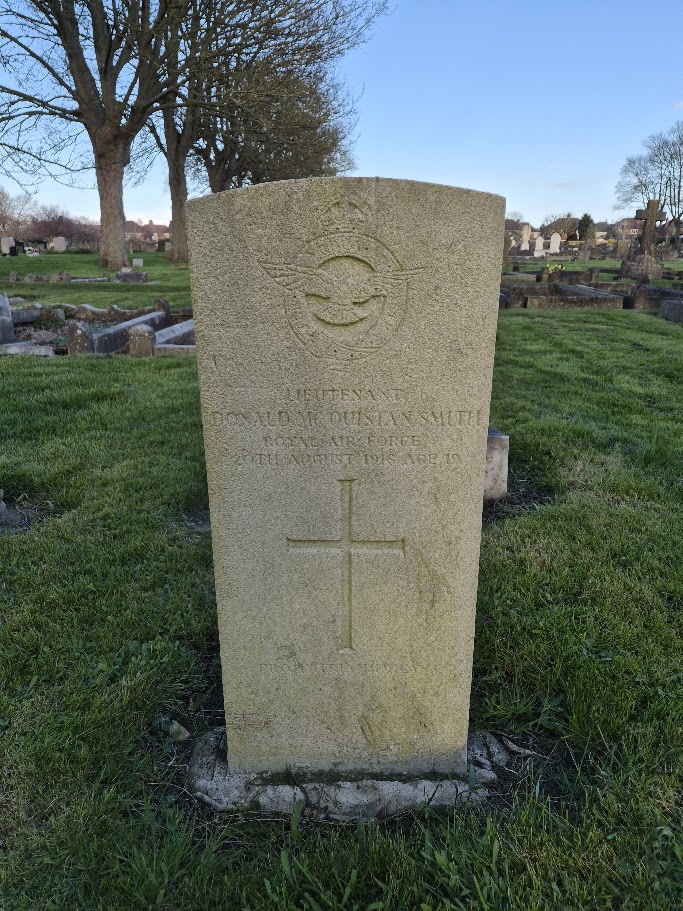


Some of the information below was supplied by ‘The Ellesmerian Club’, the alumni organisation for Ellesmere College where Donald was a pupil.
Donald McQuistan Smith arrived at Ellesmere College together with his brother, Percy Stuart, at half term in the Lent Term 1913 and they both left at the end of that year.
After he left Ellesmere, Donald went to work for a Mr. Oakley, a farmer at the Grange, Uppingham until he joined the Royal Flying Corps, on 14th May 1917. On completing his initial training he was sent to Hendon in August to learn how to be a pilot. From then he was with various training squadrons until January 1918 when he joined No. 2 Squadron.
He had been appointed 2nd Lieutenant (on probation) on 16th August 1917 and he became 2nd Lieutenant, Flying Officer Smith on 27th January 1918.
He was, however, in a London hospital throughout April 1918 which is most likely why he was not in the front line but part of the Central Despatch Pool when he was declared fit for duty on 6th May 1918.
His flying career did not last much longer for Donald was injured on 17th July when the Camel single seater fighter bi-plane E1517 which he was flying, had to make a forced landing and impacted with a hedge. He survived the crash and the subsequent inquiry learnt that he had crawled under the machine to reach the Holt flare but was struck by the propeller and the fuel ignited. He died from his injuries on 20th August at the 4thNorthern General Hospital, Lincoln. Nine other pilots lost their lives that day.
The funeral took place on 24th August at St. Nicholas Cemetery, Lincoln close to the hospital where he died. One hundred and thirty-nine of his comrades keep him company. Donald was just nineteen years old. On his headstone is engraved the college motto “Pro Patria Dimicans”
Although Donald was born in Wallasey, Cheshire, on 3rd December 1898, at the time of his death, his mother Lucy Mary was living at “Brooklands”, Uppleby Road, Parkstone, Dorset. His father, Percy, who had been an insurance broker, had died a few years before Donald’s death.
https://www.ww2cemeteries.com/uk-lincs-lincoln-newport-cemetery.html
http://www.rcawsey.co.uk/Acc1918b.htm
Lieutenant Jack Greville Moore

Jack was born in Rangoon and the son of Walter Greville and Mary Beatrice Moore and was from Tenby in Pembrokeshire. He attended St Bees School, The Foundation from 1913 – 1915 and was “very useful at all games and a tower of strength on occasions to House Junior Cricket and Football teams, and a runner of considerable promise in the Sports.” In 1915 he joined the Artists’ Rifles for eighteen months, till he was on enough for a commission. In 1916 he joined the RAF and got his wings in June 1917 and served with 81 Squadron RAF, which had been formed on 7th January 1916 at Gosport Training Unit. He was twice over France, where he did useful scouting work, and latterly was acting as instructor at a Flying school in Lincolnshire (RAF Scampton) until he was accidently killed on April 2, 1918 at the age of 19 as the result of stalling while in a spin flying ‘Camel’ D6470 is and is buried a Lincoln (Newport) Cemetery.
His medals were recently for sale via Spink who listed them with the following description

Pair: Second Lieutenant J.G. Moore, Royal Flying Corps, Killed Whilst Flying, 2.1.1918 British War and Victory Medals (2./Lieut. J.G. Moore. R.F.C.), minor edge bruise to BWM, good very fine or better (2) Estimate £ 140-180
Second Lieutenant Jack Greville Moore, born Burma, 1898, his father was a Manager of a Trading Corporation in Bombay; enlisted as Private 28th (Artist´s Rifles) Battalion London Regiment, 14.10.1915; transferred to Royal Flying Corps, as a Cadet, 8.10.1916, and was posted to Denham F.T.S. on the latter date; commissioned Temporary Second Lieutenant 27.2.1917, and posted as a Pilot to 81 Squadron; whilst flying Avro 2682, ´2/Lieut J.G. Moore ´stalled´ his machine at a height of about 100 feet and nose-dived into the ground´ (service papers refer), 11.4.1917; he rejoined his squadron, after recuperation, and after several other training postings was flying with 81 Squadron again, when he was killed whilst flying Camel D6470, 2.4.1918, at Scampton; he is buried in Lincoln (Newport) Cemetery, Lincolnshire.

Every One Remembered – Soldier Profile Lieutenant Jack greville Moore
Tenby WW1 War Memorial – WW1.Wales
108 – Pair: Second Lieutenant J.G. Moore, Royal Flying Corps, Killed W…
Private James Ewart Mathers

James Ewart Mathers was born in 1891 at Lincoln, he was the son of James an iron furnace man and Martha Mathers née Grundy of 15 Camden Street Sneinton Road Nottingham.
His father James was born in 1853 at Welton, Lincolnshire, his mother Martha Grundy was born in 1858 at Hykeham, Lincolnshire, she died in 1899 aged 41 yrs they were married in 1877 at Lincoln, they went on to have 9 children.
James emigrated to Australia before the outbreak of the ‘Great War’ when he was aged 19
Private James Ewart Mathers enlisted on 5th March 1915 at Perth Australia he was single and aged 24 yrs a labourer from Suffolk Street, Freemantle, and served with the 28th battalian Australian Infantry, he embarked from Freemantle on HMAT Ascanius on 9th June 1915. On 4th September 1915 he embarked from Alexandria disembarking at Mudros on 10th January 1916 after his evacuation from Gallipoli.
He proceeded to join B.E.F. (British Expeditionary Force) from Alexandria on 16th March, 1916 & disembarked at Marseilles, France on 21st March, 1916.
Private James Ewart Mathers was wounded in action in France on 29th July, 1916. He was admitted to No. 3 Casualty Clearing Station on 30th July, 1916 with G.S.W. (gunshot wound/s) to Head. He was transferred & admitted to 13th General Hospital at Boulogne, France on 31st July, 1916 with Skull fracture & hands. Private Mathers embarked for England on 13th August, 1916 on Hospital Ship Jan Brydel.
On 16th August, 1916 Private Mathers was admitted to King George Hospital, Stamford Street, London, England seriously ill with G.S.W. Head – severe. He was reported to be “doing very well” on 23rd September, 1916, he died on 12th October 1916 of wounds at King George Hospital, Lambeth, London, he is buried at Lincoln (Canwick Road) Cemetery, Lincoln
His sister – Mrs N. Wright, Sunnyhurst, Scorer Street, W. Lincoln wrote to Brigadier-General V.C.M. Sebllieiur, Commandant, Australian Imperial Force, London, on 2nd October, 1916 regarding Private Mathers, No. 349, 28th Battalion, 7th Australian Infantry Brigade. In her letter she requested that her brother be moved to a hospital near her before he was probably going to be sent back to Australia for his discharge.
Major K. Stuart Cross, D.M.S., A.I.F. wrote to D.D.M.S. (Deputy Director of Medical Services), London Command on 6th October, 1916, in regards to No. 349 Private Mathers, 28th Battalion, A.I.F., with the following: “I beg to request that, if convenient, you will take the necessary steps for the transfer of the above named man from The King George Hospital, Waterloo Road to 4th Northern General Hospital, Lincoln in order to be near his relatives.”
The Surgeon-General, D.M.S., A.I.F., wrote to Mrs N. Wright, Sunnyhurst, Scorer Street, W. Lincoln, on 6th October, 1916: “I am in receipt of your letter of the 2nd instant regarding your brother, and beg to inform you that his name is not down for return to Australia. I trust that it will be unnecessary to send him back, but that he will recover his health in this country, and spend his furlough with you. Meanwhile I shall try and arrange for his transfer from The King George Hospital to the 4th Northern General Hospital, Lincoln, in order to be near you.”
Private James Ewart Mathers died on 12th October, 1916 at King George Hospital, Stamford Street, London, England from wounds received in action in France – G.S.W. to Head.
He was buried in Canwick Road Cemetery, Lincoln, Lincolnshire, England – Plot number D. 1775 and now has a Commonwealth War Graves Commission headstone.

The summary was completed by Cathy Sedgwick – Facebook “WW1 Australian War Graves in England/UK/Scotland/Ireland

